A Rock Star Vampire Returns to the Stage
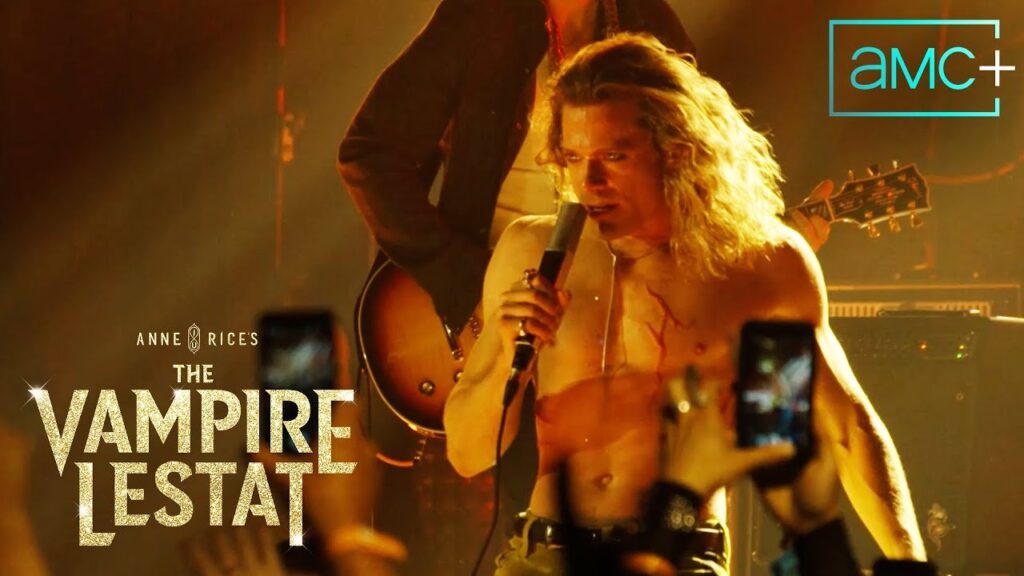
When Anne Rice published The Vampire Lestat in 1985, she made a creative leap that confounded some readers and electrified others. Her beloved antihero did not merely survive into the modern era. He became a glam rock sensation, broadcasting vampire secrets to millions of screaming fans through heavy metal lyrics and stadium pyrotechnics. It was bizarre, theatrical, and unmistakably Rice. Now, AMC showrunner Rolin Jones is bringing that same unapologetic strangeness to television, and he is not interested in sanitizing the source material to make it more palatable for mainstream audiences.
Production on the second season of AMC’s Interview with the Vampire, officially titled Anne Rice’s The Vampire Lestat, began last month in Toronto following a Comic-Con International panel in Ballroom 20. The season promises to adapt the novel that turned Rice’s universe from an intimate two-character tragedy into a sprawling mythology spanning millennia. For Jones, that means confronting head-on the elements that many considered unfilmable.
The Fealty Contract: Fidelity With Expansion
Jones established his adaptation philosophy early. At the start of AMC’s series, he made it clear to fans of Anne Rice’s The Vampire Chronicles that his series would maintain fealty to Rice’s first book and her characters, but also broaden the stories of many other characters only alluded to in Rice’s text. This is not a casual commitment. It is a structural principle that governs every creative decision.
The first season demonstrated this approach by expanding Louis de Pointe du Lac’s arc significantly beyond what appeared in Rice’s debut novel. Jones told Entertainment Weekly that the series actually expanded Louis’ arc from what is in the second novel of the same name. If the showrunner was willing to expand a central character’s journey in season one, his treatment of The Vampire Lestat’s even denser source material suggests an aggressive creative stance.
The Weirdness Threshold: Ancient Origins and Alien Entities
The Vampire Lestat novel introduces elements that push far beyond the gothic romance of Interview with the Vampire. Rice created a origin story for vampires themselves, tracing their creation to ancient Egyptian spirits named Akasha and Enkil, who were themselves merged with a blood-drinking entity called Amel. This is not subtext or metaphor. Rice wrote it as literal supernatural history, complete with ancient civilizations, psychic vampire networks, and a progenitor couple who spent millennia as living statues.
Adapting this material requires a showrunner willing to risk absurdity. The rock star premise alone forces a tonal shift that many adaptations would soften or reimagine. Rice herself recognized the audacity of her own creation. As noted in discussions of her work, she jumped on the goth rock wagon she herself had set in motion and put Lestat on the rock stage. The author did not hedge. She committed fully to the conceit that a centuries-old vampire would choose mass media as his weapon against vampire secrecy.
Jones appears to be matching that commitment. The Comic-Con tease and production details suggest the rock star era is not being reimagined as metaphor or dream sequence. It is being staged as reality within the show’s world.
Rice’s Own Adaptation Anxiety: A Precedent for Skepticism
The history of Rice’s relationship with adaptations adds weight to Jones’ approach. Rice initially refused to watch the 1994 film adaptation of Interview with the Vampire, only changing her position after viewing a VHS copy. This initial refusal reflected deep anxiety about how her characters would be translated to screen. She eventually praised the film, but her protective stance established a standard that any adapter must consider.
For Jones, the lesson is clear. Dilation of Rice’s weirdness would not honor her vision. It would betray it. Rice’s work succeeded precisely because she pushed past conventional vampire fiction into territory that was operatic, philosophical, and strange. An adaptation that strips away the rock concerts and ancient spirits to focus on safe gothic aesthetics would miss what made The Vampire Chronicles culturally significant.
Why the Strangeness Matters for Long-Term Viability
AMC has invested heavily in Rice’s Immortal Universe, and the franchise’s long-term viability depends on distinguishing itself from the crowded vampire media landscape. AMC’s adaptation was recognized as a wholly fresh take that remains true to the franchise. That balance between freshness and fidelity is the core creative challenge.
The weirdest elements of Rice’s mythology are also the most distinctive. Every vampire story has brooding immortals and tragic romance. Very few have ancient Egyptian spirit entities, psychic vampire networks, and a protagonist who responds to existential crisis by starting a band. These elements are not bugs in Rice’s system. They are features that separate her work from every other bloodsucker narrative in popular culture.
Jones’ willingness to embrace this material signals confidence in the audience’s capacity for the fantastical. The first season’s critical and audience reception suggests viewers are ready for Rice’s universe presented without apology. Season two will test whether that receptivity extends to the novel that transformed the series from character study into cosmic myth.
The answer to that question will determine whether AMC’s Immortal Universe becomes a sustainable franchise or a limited adaptation that peaked with its most conventional material. Jones is betting on the weird. Given Rice’s own creative trajectory, that bet has historical precedent on its side.